Meiju Väisänen - Kuvataiteilija/Visual artist - Helsinki - Bio/CV
Maalaan ymmärtääkseni, mitä olen nähnyt. Maalaan katsoakseni uudelleen.
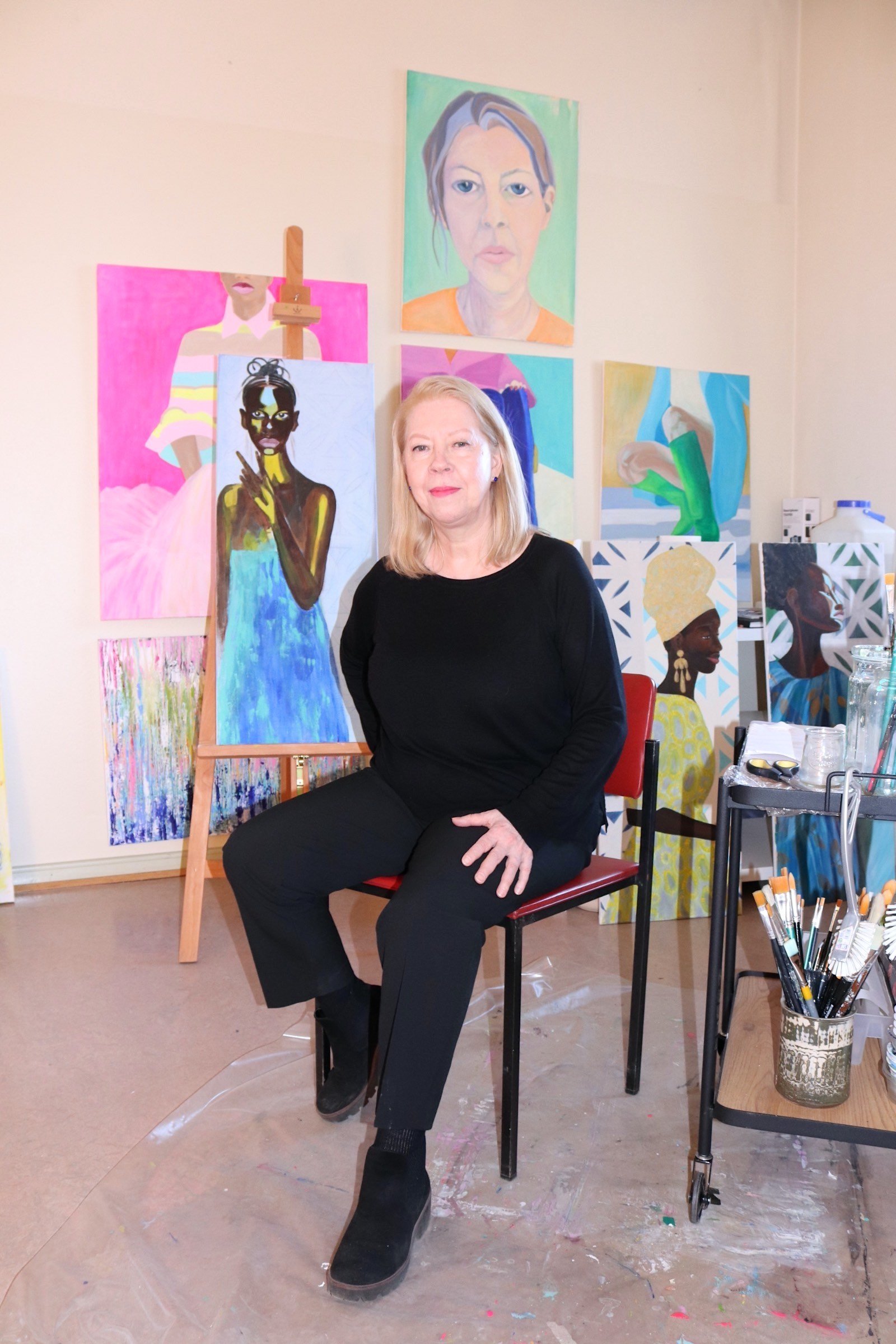
Taiteeni keskiössä on ihminen, ihmisen kuva. Ihminen ei kuvissani synny vain kasvoista tai ilmeestä, vaan suhteessa siihen, mitä hän kantaa yllään, ihollaan ja ympärillään; pinnoilla, joihin kirjoittuu kulttuuri, aika, muistot, kokemukset ja oma katseemme toiseen ihmiseen.
Ilmaisuni liikkuu emotionaalisen realismin ja abstrahoidun välimaastossa. En pyri tunnistettavuuteen tai näköisyyteen. Toisinaan kuva säilyy hyvin realistisena, ei kuvaamassa tiettyä ihmistä, vaan pikemminkin tunnistettavaa tunnetta tai kokemusta. Toisinaan se hajoaa lähes abstrakteiksi pinnoiksi ja hahmo rakentuu väristä, muodosta, pinnoista ja kompositiosta. Ihminen voi jäädä osittain näkyviin, rajautua kuvan ulkopuolelle tai muuttua vähitellen osaksi maalauksen rakennetta.
Maalauksissani lähden usein liikkeelle jostain hetkellisestä havainnosta, visuaalisesta häivähdyksestä, joka jää vaivaamaan. Se voi olla jokin yksityiskohta tai kuvioyhdistelmä, joka näyttää yhtäkkiä erilaiselta ja kiinnostavalta ja jää mieleeni. En aina tiedä, miksi juuri kyseinen havainto alkaa kiinnostaa. Maalaamalla palaan havainnon äärelle ja annan kuvan vähitellen kertoa, mitä oikeastaan näin. Maalaan katsoakseni tarkemmin.
Pidän energisistä väreistä, kuviosta ja koristeellisuudesta. Minua kiinnostaa, miten kevyt, leikkisä ja kaunis voi olla samalla painavaa ja koskettavaa. Minua kiinnostaa hetki, jolloin visuaalinen leikki alkaa paljastaa jotakin vakavaa.
Kuva ei koskaan ole vain kuvattavan ihmisen kuva. Se kertoo myös kuvaajan katseesta.
Olen kaksikulttuurisen perheen äiti ja tarkastelen maailmaa myös tästä positiosta käsin. Eläminen erilaisten kulttuuristen ympäristöjen yhteydessä on tehnyt minut tietoiseksi siitä, ettei tapamme nähdä ihmisiä ole koskaan neutraali. Visuaaliset muistot, kulttuuriset kokemukset ja erilaiset katsomisen tavat tulevat osaksi sitä, miten rakennamme kuvaa toisesta ihmisestä. Olen kiinnostunut siitä, miten nämä erilaiset visuaaliset maailmat kohtaavat taiteessani.
Taustani elokuvan pukusuunnittelijana ja opetustehtävissä yliopistossa elokuvataiteen laitoksella, ovat muovanneet tapaani katsoa kuvaa paikkana jossa henkilöhahmot ovat osana kerronnallista ja visuaalista maailmaa, kollektiivisesti luotua elokuvan maailmaa.
Kuvataide on minulle pukusuunnittelijan taiteellisen työn jatkumoa ja se antaa minulle mahdollisuuden katsoa ihmistä toisin, omaehtoisesti ja itsenäisesti kun kollektiivisen taiteen tekemisen tilalle on tullut yksin työskentelevän taiteilijan tila, jossa voin pysähtyä ja katsoa tarkemmin sitä mitä kuvassa ehkä rajautui kuvan ulkopuolelle tai liikkui ohi.
Kuvan rajasta on tullut minulle tärkeä merkityksiä kantava paikka maalauksissani, eräänlainen välitila. Missä maalaus oikeastaan päättyy? Maalauksissani kompositio voi ehdottaa, että kuva jatkuu maalauksen ulkopuolelle, tai maalauksen reunasta muodostuu sisällöllisesti tärkeä osa teosta.
Teoksiini on alkanut muodostua tekstiilisiä reunoja ja kehyksiä, jotka ovat teoksen sisältöön olennaisesti kuuluvia ja muodotavat yhdessä maalauksen kanssa erottamattoman kokonaisuuden. Tekstiilistä ja muista pehmeistä materiaaleista on tullut yhä tärkeämpi osa maalauksiani, merkityksiä kantavina elementteinä. Ajattelen yhä useammin itse maalauspohjaa kankaana, jota voi ommella, kirjoa, liittää toisiinsa ja muotoilla, kuten olen työstänyt näitä materiaaleja pukusuunnittelijana.
I paint to understand what I have seen. I paint to look again.
At the centre of my art is the human being, the image of the human. In my work, a person does not emerge only through the face or expression, but in relation to what they wear, what they carry on their skin, and what surrounds them; through surfaces on which culture, time, memories, experiences, and our own gaze upon another person are inscribed.
My work moves between emotional realism and abstraction. I am not aiming for recognisability or likeness. At times, the image remains highly realistic, not depicting a particular person, but rather a recognisable feeling or experience. At other times, it breaks down into almost abstract surfaces, and the figure is constructed through colour, form, surfaces, and composition. The human figure may remain only partially visible, extend beyond the edge of the image, or gradually become part of the structure of the painting.
I often begin my paintings with a fleeting observation, a visual glimpse that stays with me. It may be a detail or a combination of patterns that suddenly appears different and intriguing, and remains in my mind. I do not always know why a particular observation begins to interest me. Through painting, I return to the observation and allow the image to gradually reveal what it was that I actually saw. I paint in order to look more closely.
I am drawn to energetic colours, patterns, and ornamentation. I am interested in how something light, playful, and beautiful can at the same time be weighty and moving. I am interested in the moment when visual play begins to reveal something serious.
An image is never only an image of the person depicted. It also reveals the gaze of the person looking.
As the mother of a bicultural family, I also view the world from this position. Living in relation to different cultural environments has made me aware that the way we see people is never neutral. Visual memories, cultural experiences, and different ways of seeing become part of how we construct an image of another person. I am interested in how these different visual worlds meet in my work.
My background as a film costume designer, together with my teaching work at a university department of film, has shaped the way I look at the image as a space in which characters exist as part of a narrative and visual world, a collectively created world of film.
For me, visual art is a continuation of my artistic work as a costume designer. It gives me the possibility to look at the human figure differently, independently and on my own terms. In place of the collective process of making art, I have entered the space of the artist working alone: a space in which I can pause and look more closely at what may have been cropped out of the image, or what moved past it.
The edge of the image has become an important site of meaning in my paintings, a kind of in-between space. Where does a painting actually end? In my work, the composition may suggest that the image continues beyond the edges of the painting, or the edge itself may become an essential part of the content of the work.
Textile edges and frames have gradually become part of my works, elements that are essential to their content and form an inseparable whole together with the painting. Textile and other soft materials have become increasingly important in my work as elements that carry meaning. I increasingly think of the painting support itself as a piece of fabric that can be sewn, embroidered, joined together, and shaped, much as I have worked with these materials as a costume designer.